
Focus Areas
Our Seven Healthcare Affordability ChallengesHealthcare affordability requires addressing interconnected challenges across how care is financed, delivered, administered, and governed. RUSH has organized its research into seven areas, each defined by a central problem framing and its underlying elements.
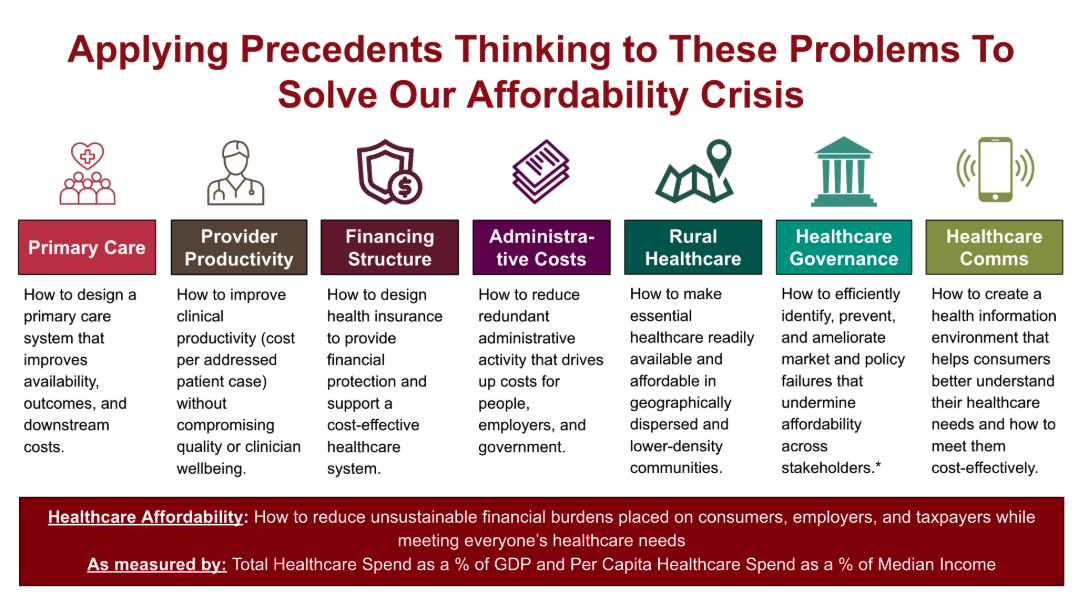
Our overarching goal is healthcare affordability: How to reduce unsustainable financial burdens placed on consumers, employers, and taxpayers while meeting everyone’s healthcare needs, as measured by 1) Total healthcare spending as a percentage of GDP & 2) Per capita healthcare spending as a percentage of median income.
Primary Care & Prevention
Problem Framing: How to design a primary care system that improves availability, outcomes, and downstream costs.
Key Elements
- Payment: How to organize payment modalities to better align with health promotion, prevention, and quality.
- Capacity: How to ensure sufficient availability of primary care services wherever people live.
- Continuity: How to ensure individual continuity and consistency of primary care services (24/7/365).
- Technology: How to ensure that AI and other emerging technologies catalyze cost-effective primary care.
Provider Productivity
Problem Framing: How to improve clinical productivity (cost per addressed patient case) without compromising quality or clinician wellbeing.
Key Elements
- Process Design: How to ensure that clinical processes are performed by the most cost-effective person or technology.
- Incentives: How to reward provider productivity without compromising quality of care and clinician wellbeing.
- Technology: How to ensure AI and other emerging technologies increase provider productivity rather than adding work, shifting burdens, or generating unnecessary demand.
- Training: How to increase clinical productivity through novel approaches to medical training.
Financing Structure
Problem Framing: How to design health insurance to provide financial protection and support a cost-effective healthcare system.
Key Elements
- Distribution: How to distribute the funding of healthcare costs and financial risks across people, insurers, employers, and governments to improve affordability.
- Continuity: How to ensure that people have continuous health maintenance and financial protection throughout their lives.
- Incentives: How to motivate consumer, employer, and government behaviors to increase the affordability of health insurance and costs.
Administrative Costs
Problem Framing: How to reduce redundant administrative activity that drives up costs for people, employers, and government.
Key Elements
- Fragmentation: How to simplify the complexity created by the proliferation of different processes aimed at achieving the same goal.
- Infrastructure: How to modernize an antiquated system for effecting payment transactions.
- Incentives: How to motivate behaviors that reduce redundant administrative activity.
- Technology: How to ensure that non-clinical technologies reduce administrative activity with no incremental value.
Rural Healthcare
Problem Framing: How to make essential healthcare readily available and affordable in geographically dispersed and lower-density communities.
Key Elements
- Workforce: How to build, attract, and retain a sufficient healthcare workforce.
- Infrastructure: How to overcome the lack of scale and scope economies in small markets.
- Finance: How to fund the provision of healthcare services in low-income, low-volume communities.
Governance
Problem Framing: How to efficiently identify, prevent, and ameliorate market and policy failures that undermine affordability across private and public stakeholders.
Key Elements
- Accountability: How to establish accountability across a complex, interdependent web of industry and government entities.
- Coordination: How to ensure that healthcare policies and regulation at every level of government work for rather than against each other.
- Enforcement: How to improve the quality, speed, cost, and rewards of addressing rent-seeking and fraudulent behaviors.
- Infrastructure: How to modernize shared infrastructure that may contribute to inefficiencies in healthcare markets.
Health Communication
Problem Framing: How to create a health information environment that helps consumers better understand their healthcare needs and how to meet them cost-effectively.
Key Elements
- Misinformation: How to reduce the proliferation of disingenuous, misleading, and deceitful information online.
- Translation: How to convey complex and evolving health evidence into information that is accurate, accessible, and useful for different audiences and decisions.
- Trust: How to solve the mistrust that many consumers have toward the medical establishment.
- Rewards: How to motivate the continuous spread of accurate information at scale in a decentralized information environment.